
Walk an inspection mission through interruption and recovery
Define a bounded inspection route, interrupt it deliberately and review the conditions for a controlled restart. This is a planning walkthrough: no robot is connected and no safety result is established.
Free to explore. Worksheet inputs stay in this browser tab; no account or paid API is required.
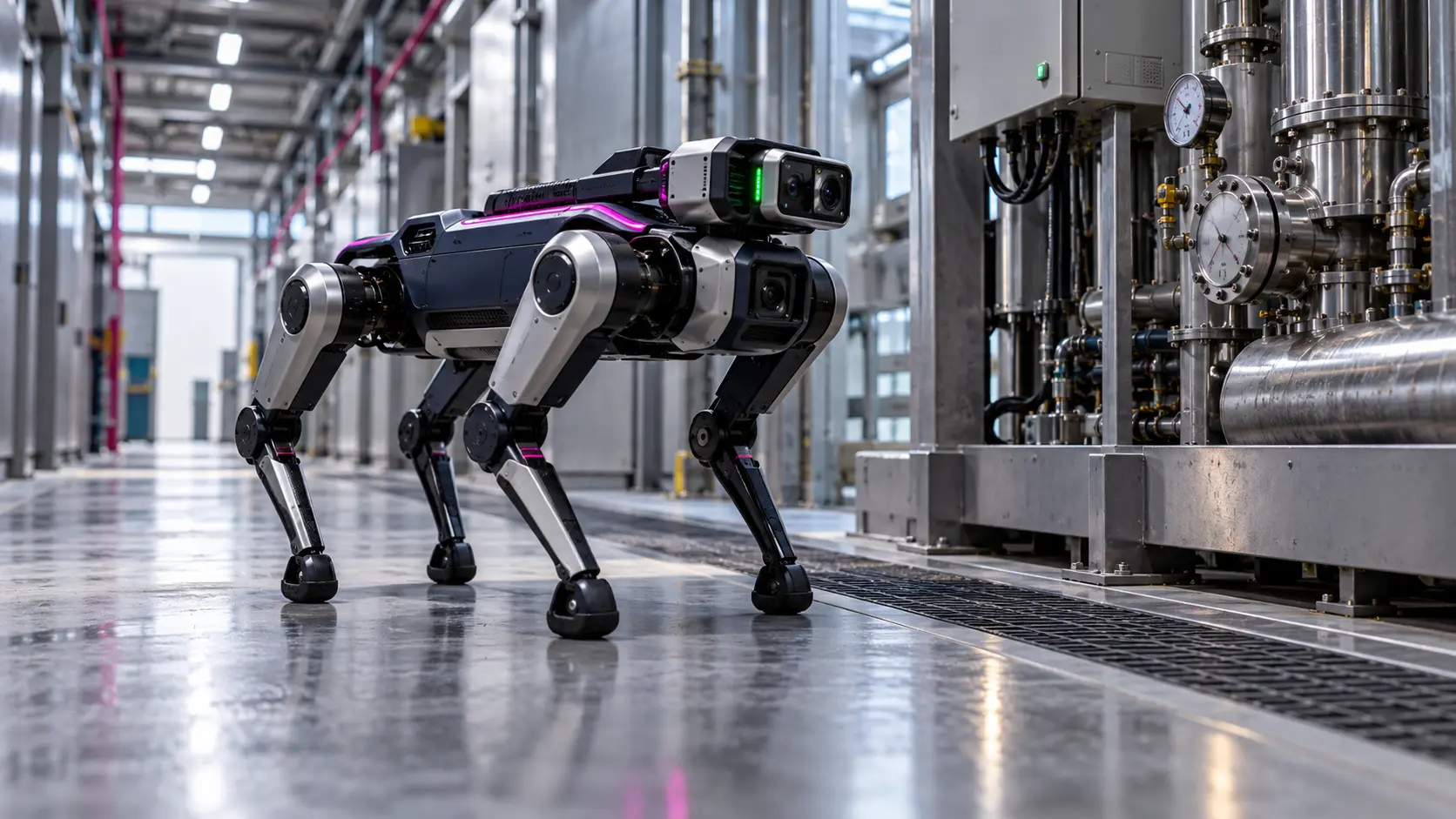
The layout, numbers and events are fictional planning inputs. Site hazards, stopping performance, sensing, controls and applicable requirements need assessment on the actual platform and environment.
Define the mission boundary
Before a trial, name the permitted route, task, people-exclusion rules, stop conditions and operator authority. Distinguish a planning drawing from a surveyed map. A route that looks clear in a diagram may contain reflective surfaces, moving people, steps or connectivity gaps.
Walk the interruption and recovery states
IDLERecovery review conditions
Reconnection alone does not resume inspection. In the review state, all three conditions are required for the simulated reset. This models an explicit decision boundary; it is not a certified control implementation.
Inspect an idealised stopping-distance model
The model adds travel during a delay to constant-deceleration braking: d = v × t + v² / (2a). It assumes level travel, constant speed during the delay and constant positive deceleration afterwards. It excludes slope, traction changes, controller limits, jerk, localisation error and safety margins.
A real acceptance test requires measured traces and a justified limit for the actual operating envelope. Do not use this model output as a safe separation distance.
What evidence should the pilot retain?
- Task and route boundaries, with the operator and decision owner named.
- Mission and operator timelines, including interruptions and outstanding commands.
- Observation quality at each inspection point, not simply a completed route.
- Measured energy, connectivity and recovery behaviour under the chosen conditions.
- Unresolved hazards and explicit conditions for stopping or narrowing the pilot.
For lifecycle context, see the ROS 2 managed-node design. A software lifecycle does not by itself establish robot safety.
Take the next step with context
Keep the question, assumptions and evidence together. These tools help organise a review; an exported record does not approve a design or certify a system.