
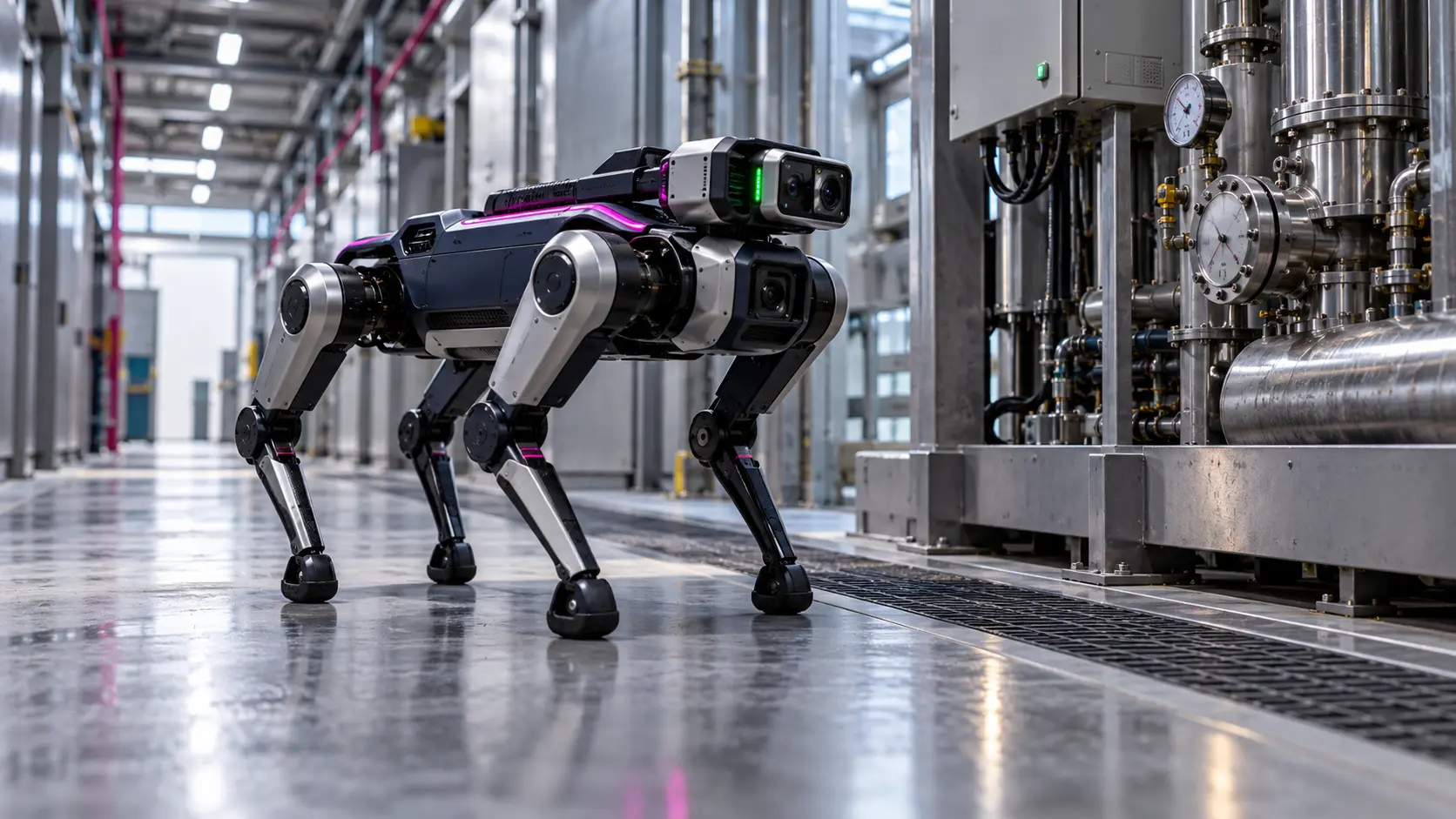
A robot completing one impressive circuit of a building is a demonstration. A robot performing a repeatable inspection, recording useful evidence and handling an interrupted mission is an operating capability. The difference becomes clear when a door is closed, a person enters the route, the network disappears or the battery estimate proves optimistic.
For a quadruped, wheeled platform or humanoid, the starting point is the same: define the work and the conditions under which it is allowed to proceed. This article uses a fictional indoor equipment-inspection mission to explain how to move from a successful run to a pilot that a site team can evaluate. It concerns mission design and evidence; it is not a substitute for a site-specific safety assessment or machinery compliance work.
The situation: define the inspection result
“Patrol the facility” leaves too much unstated. Our example is more specific: visit six equipment stations in an agreed indoor area, capture a labelled image of each indicator, and return the observations for a human reviewer. The robot does not change equipment settings, enter occupied restricted rooms or decide that a machine is safe to operate.
This description separates movement from the business result. Reaching all six locations is not enough if two photographs are blurred or attached to the wrong station. Equally, a mission that stops after four stations can still provide useful partial evidence if it reports the missing observations clearly.
Define the completion record before choosing a route. For each station, retain its identity, capture time, sensor configuration and image-quality status. Include the mission version, route version and any intervention. The reviewer should be able to distinguish “not visited”, “visited but no usable observation” and “observation available”.
What to inspect: the operating conditions
The robot needs a defined operating envelope: the conditions in which the mission is permitted. For the fictional pilot, that might include a mapped indoor area, an agreed lighting range, a defined floor condition and a supervised time window. These are example boundaries, not universal limits for a particular robot.
State the conditions that require a pause or an end to the mission. They could include localisation uncertainty, an unexpected obstruction, a sensor fault or loss of required operator context. The appropriate response depends on the platform and environment. “Stop immediately” is not a complete design unless the team has considered where and how stopping can occur.
A software pause, a protective stop and an emergency stop are different concepts. A mission application should not claim that its ordinary state transition provides a safety function merely because it prevents the next navigation command. Safety-related controls require their own justified design, integration and verification.
Questions to ask: what state is the mission in?
Use explicit states so that an operator can tell what the robot is doing and what must happen next. The example below describes application-level mission states. It is deliberately separate from the lifecycle states of individual software components or the robot’s safety controller.
ROS 2 managed nodes provide a defined lifecycle for software components, including configuration, activation and cleanup. That can help coordinate startup and recovery. It does not by itself define whether an inspection mission is acceptable or establish a safety-rated control function. Keep component readiness, mission progress and safety status visible as separate concerns.
For example, a camera node can be active while its images are unsuitable because of glare. A navigation component can be running while localisation quality is outside the mission’s permitted conditions. The mission must evaluate the conditions relevant to its task, rather than treating process availability as proof of readiness.
Signals: test interruptions and operator context
Begin with controlled tests in an appropriate test area. Introduce the kinds of interruption that the design claims to handle, with the permissions and precautions required for the platform. Record the expected state transition, the observed response and the information shown to the operator.
| Interruption | Question to answer | Evidence to retain |
|---|---|---|
| An inspection point is inaccessible | Does the mission pause, skip or end according to its approved rules? | State changes, reason and missing-observation record |
| The camera image is unusable | Can the system distinguish arrival from successful inspection? | Image, quality result and permitted retry outcome |
| The operator loses video | Is control authority consistent with the available context? | Both operator and robot timelines |
| The robot reconnects after a delay | Are old commands rejected or reconciled? | Command identifiers, timestamps and acknowledgements |
Network loss deserves several distinct tests. Loss of video, loss of command delivery and loss of status feedback create different uncertainties. A remote operator may be connected to one channel while another is stale. The interface should make freshness visible and avoid displaying an old frame as if it were current.
Recovery is part of the test. When the network returns, the robot and operator need to agree on mission state and control authority. Replaying a queue of old movement instructions can be inappropriate even when every instruction was valid when issued. Define the acceptance rule for commands rather than assuming a transport reconnection resolves the task.
Actions: measure useful work
For the six-station example, report how many observations were usable, how long the full mission took, how much operator intervention was required and which conditions caused incomplete work. Keep interrupted missions in the dataset. Removing them because they did not finish makes the pilot look smoother while concealing its operating burden.
Power measurements should follow the mission profile. Walking, standing, sensing, computing and transmitting can place different demands on the platform. Record the actual sequence and environmental conditions, then compare the estimate with measured runs. A single average power figure can hide peaks or reserves that constrain the mission.
Use repeated runs under documented conditions. If the route changes, the lighting changes or a software update changes the perception behaviour, identify that difference in the record. Do not combine incompatible runs into a single percentage that suggests a level of repeatability the evidence does not establish.
Escalation triggers: give the site team a process
A pilot needs an owner for preparation, operation, review and recovery. Who checks the route before a run? Who reviews uncertain observations? Who can resume a paused mission? Who retrieves the robot if it cannot continue? Those responsibilities belong in the operating plan before expansion to more routes or longer unattended periods.
Define a release boundary for the pilot and the evidence required to change it. Adding a staircase, a different floor surface or a manipulation task is a change in the mission, even if the same robot hardware is used. Review the new conditions instead of treating previous success as blanket approval.
The practical goal is a mission that produces understandable results and fails in an understood way. A robot that stops for a defined reason, preserves partial observations and gives the operator a clear next step can be more useful than a robot that completes a route while concealing uncertainty. Evaluate the work the organisation receives, together with the effort needed to support it.
Technical reference
ROS 2 design: managed nodes describes the component lifecycle concept. The inspection mission, state diagram and pilot tests above are illustrative engineering examples and are not a claim of platform certification.